Abiding Times by Tunku Zain Al-'Abidin Muhriz
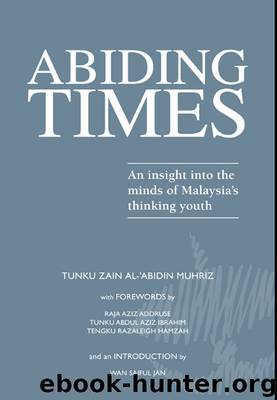
Author:Tunku Zain Al-'Abidin Muhriz
Language: eng
Format: epub
ISBN: 9789814382809
Publisher: Marshall Cavendish
35
More Reforms Must Follow
‘Abiding Times’, theSun, 3 July 2009
DATO’ SRI NAJIB RAZAK’S economic liberalisation seems real, profound and courageous; one wishes such zeal were seen in other areas in need of reform as well. Nonetheless, with two swift strokes of the axe he has decapitated within his first 100 days as Prime Minister some of the most odious economic policies that his predecessors failed to repeal. He is, it must be said, aided by two important factors. First is necessity: it is now universally accepted that foreign investors will simply go elsewhere unless we make Malaysia more attractive. Second is the acceptance—or grudging tolerance—for such reform measures among the economic nationalists within his party. As a trump card to out-reform the Pakatan, it may just work, especially if the opposition then have an internal bicker about whether to oppose these measures on socialist or ethno-nationalist grounds, or conversely to criticise the government for not being liberal enough.
Justifying the measures in his keynote address at Invest Malaysia 2009, the Prime Minister acknowledged that ‘the economic environment regionally and globally has changed drastically since the inception of the NEP’ and that ‘the Foreign Investment Committee as an instrument has not produced the desired results over the last 19 years’. Minister in the Prime Minister’s Department in charge of the Economic Planning Unit, Tan Sri Nor Mohamed Yakcop added that the ‘FIC was a hindrance to growth’.
“Malaysia’s performance in controlling corruption has not improved since 2003.”
While the 30 percent bumiputera equity requirement remains—maintaining the principle that a certain group of citizens defined by government ought to own a certain share of the nation’s wealth—it does so as a macro objective to be arrived at by the respective sectors themselves. It is an important indication that Najib is prepared to trust the market instead of wielding regulatory powers to obey government diktat.
If this trust is secured and built upon, it will open up avenues to further encourage the growing of the economic pie, and furthermore, transfer control over our money from the government to individual citizens.
For instance, efforts to bring our numerous Free Trade Agreements still under negotiation to fruition could be stepped up, though these inevitably take time. Securing multilateral agreement is an even slower prospect, as the Doha Round experience indicates. Fortunately, there is much we can do unilaterally to liberalise trade, as we did successfully in the 80s and 90s by reducing a slew of tariffs (other distortions to the economy such as faux ‘privatisation’ notwithstanding). While many of the tariffs in force today are on essential goods, tariff elimination is viable especially if done gradually: rises in inflation met with commensurate reduction in tariffs. Subsequent drops in prices would mean government having to spend less on subsidies in order for consumers to pay current prices. This may help to alleviate the government’s fiscal burden, with savings ultimately passed to the taxpayer.
Furthermore, our tax system could be decentralised so that rather than us paying taxes to federal government, which then disburses
Download
This site does not store any files on its server. We only index and link to content provided by other sites. Please contact the content providers to delete copyright contents if any and email us, we'll remove relevant links or contents immediately.
| Anthropology | Archaeology |
| Philosophy | Politics & Government |
| Social Sciences | Sociology |
| Women's Studies |
The remains of the day by Kazuo Ishiguro(9094)
Tools of Titans by Timothy Ferriss(8501)
Giovanni's Room by James Baldwin(7441)
The Black Swan by Nassim Nicholas Taleb(7202)
Inner Engineering: A Yogi's Guide to Joy by Sadhguru(6839)
The Way of Zen by Alan W. Watts(6676)
The Power of Now: A Guide to Spiritual Enlightenment by Eckhart Tolle(5857)
Asking the Right Questions: A Guide to Critical Thinking by M. Neil Browne & Stuart M. Keeley(5839)
The Six Wives Of Henry VIII (WOMEN IN HISTORY) by Fraser Antonia(5561)
Astrophysics for People in a Hurry by Neil DeGrasse Tyson(5228)
Housekeeping by Marilynne Robinson(4508)
Double Down (Diary of a Wimpy Kid Book 11) by Jeff Kinney(4340)
12 Rules for Life by Jordan B. Peterson(4334)
Ikigai by Héctor García & Francesc Miralles(4314)
The Ethical Slut by Janet W. Hardy(4312)
Skin in the Game by Nassim Nicholas Taleb(4311)
The Art of Happiness by The Dalai Lama(4170)
Skin in the Game: Hidden Asymmetries in Daily Life by Nassim Nicholas Taleb(4053)
Walking by Henry David Thoreau(4006)
